
PUT YOUR PLANT'S KNOWLEDGE TO WORK ON EVERY SHIFT
PUT YOUR PLANT'S KNOWLEDGE TO WORK ON EVERY SHIFT
PUT YOUR PLANT'S KNOWLEDGE TO WORK ON EVERY SHIFT
PUT YOUR PLANT'S KNOWLEDGE TO WORK ON EVERY SHIFT
PUT YOUR PLANT'S KNOWLEDGE TO WORK ON EVERY SHIFT
Your most experienced operators and engineers know why your plant behaves the way it does. Orise helps you put that knowledge to work on every shift. We build industrial AI agents on a verified model of your own plant knowledge, so operators and engineers get context-aware advice on alarms, control loops and process problems while staying in charge of every decision.
This is a practical first step toward supervised autonomous operations, taken at a pace your plant can trust.
An aging workforce and skilled-staff shortages are pushing overtime into control rooms, adding complexity and inconsistency across shifts.
Orise’s Industrial Agentic AI keeps expert knowledge available on every shift, so managers do more with the team they have.
Alarm floods and manual control-loop work compete for limited expert time.
What if agents explained what’s happening and pointed to the relevant knowledge? Operators move from reacting to anticipating, and less experienced staff take on tasks like PID tuning with more confidence.
Faster, better-informed decisions. Agents combine live data with operational context, so deviations get caught before they grow. Decades of process automation and APC experience connect plant knowledge to where performance is actually won or lost.
Knowledge that stays, with faster time to competence. A maintained knowledge graph puts years of operating experience within reach of every shift. Orise interviews your people on site and combine what they know with P&IDs, procedures, and DCS data. Everything is confirmed, tested, and traceable to its sources.
Aligned teams, built on what you already own. Agents connect findings across operations, maintenance, and engineering. As a system-agnostic integration partner, Orise works with your existing DCS, historian, and data infrastructure.
Continuous improvement, not a one-off project. Agents keep learning from new operating data. Our lifecycle service monitors performance, captures feedback, and extends proven agents to new units.
More expert time, a calmer control room. Agents take on data gathering and repetitive workflow steps, freeing people for the complex problem solving and judgment calls that matter most.
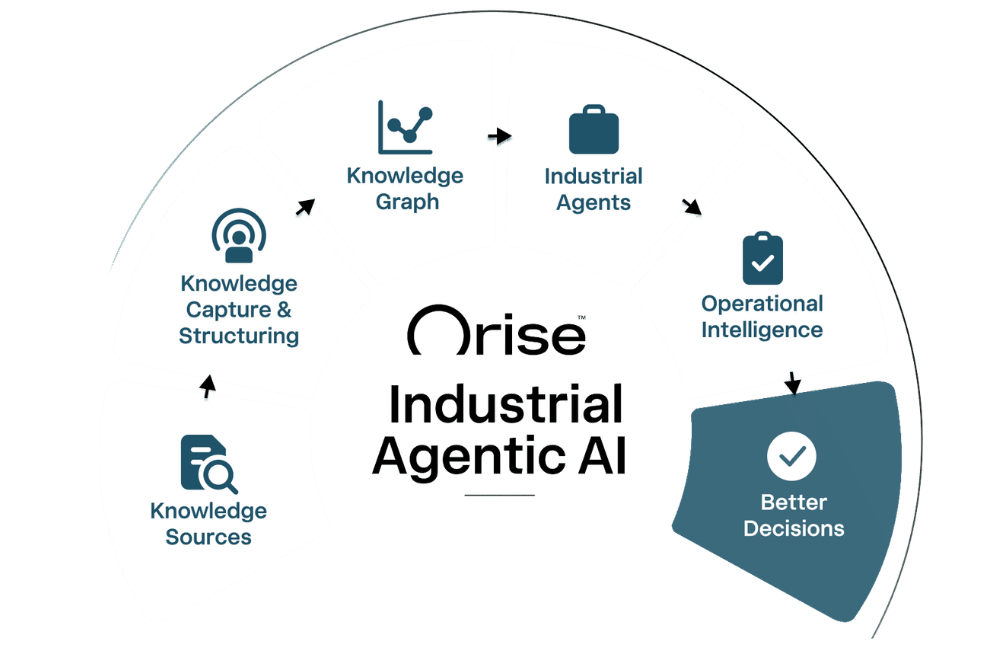
Step 1. Build a connected foundation: Optimize controls and reliability, then connect data, documentation, and knowledge in one model.
Step 2. Augment people and systems: Apply AI to controls, engineering, alarms, and maintenance to strengthen existing workflows and close gaps.
Step 3. Move toward supervised execution: Progress from recommendations to defined AI autonomy.
Step 4. Scale into an autonomous operating model: People set objectives; agents coordinate within validated boundaries.
Unlocking your full potential
40+ years of automation history. 1,600+ employees across 20 countries. 5,000+ projects a year, including work in chemicals, energy, pharma, and biotech. In industrial agentic AI, Orise has completed three customer proofs of concept, including one in fertilizer production, and is building a reusable framework tailored to each plant’s knowledge and systems.
Adopting agentic AI responsibly
Agents advise. Operators decide. Every agent’s design sets out what it may and may not do, agreed with your operations and safety teams. Language models interpret and combine information, while trusted engineering methods handle the critical calculations. Sensitive data stays in a controlled plant environment, with cloud models used only through ring-fenced subscriptions. Every decision is auditable.
Where could agentic AI fit in your plant? The possibilities are vast — alarm load, control-loop performance, retaining operator knowledge, but a useful first step starts with one concrete challenge. Start the conversation with Orise about what a first proof of concept would involve.
Unlock your full potential.
Frequently Asked Questions About Agentic AI in Manufacturing


Software agents that gather plant data and knowledge, reason about it, and take agreed workflow steps — typically supporting alarm handling, control-loop tuning, and troubleshooting, with people reviewing what they recommend.
Generative AI and chatbots answer a prompt. An agent pursues an outcome, triggered by a plant event, drawing on a verified model of your plant rather than general knowledge.
No. Agents advise while operators decide. The DCS, APC, and safety systems stay fully in place.
With one operational problem. An assessment ranks use cases by value, feasibility, and risk before development begins.
No. Readiness gets assessed at the start, and gaps get addressed where they matter for the chosen use case.
Knowledge and data stay in a controlled local environment. Cloud models are accessed only through ring-fenced subscriptions, sharing only what a task requires. Grounding agents in a knowledge graph confirmed by internal experts, with traceability to source documents, and using engineering methods for critical calculations allreduce hallucination risk.